
Understanding your face shape can make a noticeable difference in how you choose hairstyles, glasses, makeup, and other personal styling options. Every person has a unique facial structure, influenced by the width of the forehead, cheekbones, jawline, and the overall length of the face. Although these features may seem like small details, they play an important role in determining which styles complement your natural appearance. Identifying your face shape is a simple way to understand your proportions and make more confident styling decisions.
A face shape calculator offers a convenient way to explore your facial structure without needing professional assistance. Instead of relying entirely on guesswork, you can use basic facial measurements or a clear photograph to estimate your face shape. The result can help you understand whether your face is oval, round, square, heart-shaped, diamond-shaped, or oblong. While no digital tool can perfectly describe every individual face, it provides a useful starting point for discovering your natural proportions.
Today, online beauty and grooming tools have made personal styling more accessible. People can explore different looks, compare facial proportions, and understand which choices may complement their features. Learning about your face shape is not about following strict beauty standards. It is about finding styles that make you feel comfortable, confident, and authentic.
What Is a Face Shape Calculator?
A face shape calculator is a digital tool designed to estimate the shape of your face by examining specific facial proportions. It generally considers four important measurements: forehead width, cheekbone width, jawline width, and face length. By comparing these measurements, the tool identifies the closest matching facial category.
Some calculators allow users to enter measurements manually, while others use photographs and facial recognition technology to estimate proportions. Photo-based systems may analyze the distance between facial landmarks, including the temples, cheekbones, chin, and jawline. Based on the relationship between these points, the system suggests a possible face shape.
The main purpose of this tool is to simplify something that people often find confusing. Many individuals struggle to distinguish between oval and oblong faces or between square and round faces because the differences can be subtle. A measurement-based approach provides additional clarity and helps users understand why their facial structure belongs to a particular category.
However, the result should be considered an estimate rather than a permanent classification. Human faces naturally contain variations, and some people have characteristics associated with two different face shapes.
Why Knowing Your Face Shape Matters
Understanding your facial proportions can help you make more informed decisions about your appearance. For example, someone with a round face might prefer a hairstyle that adds height, while someone with a longer face may enjoy styles that create additional width around the sides. These are not strict rules, but they demonstrate how facial structure can influence the overall appearance of a hairstyle.
The same understanding can be useful when selecting eyewear. Different frame shapes interact with facial proportions in different ways. Angular frames may create contrast with softer facial contours, while rounded frames can complement naturally angular features. Knowing your facial structure gives you a helpful reference when comparing different designs.
Makeup application can also become easier when you understand the natural shape of your face. Contouring, blush placement, and highlighting techniques can be adjusted to complement your cheekbones, forehead, and jawline. Rather than copying every beauty trend, you can experiment with techniques that suit your individual features.
A face shape calculator is therefore useful for more than identifying a category. It provides a foundation for exploring personal grooming, fashion, and beauty choices with greater awareness.
Different Types of Face Shapes
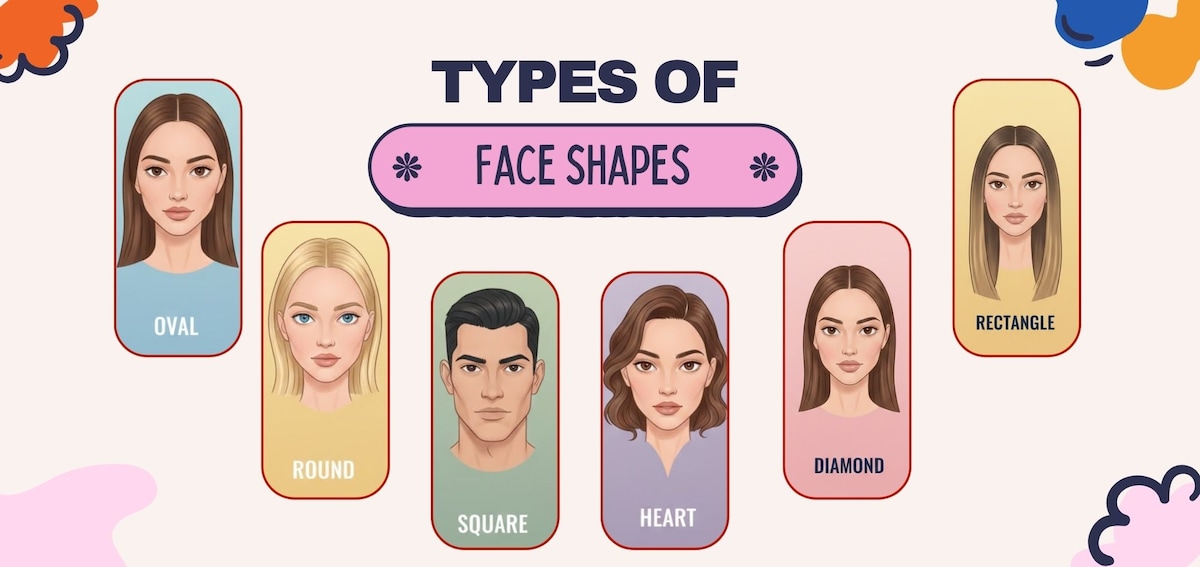
There are several commonly recognized face shapes. Each category is based on the relationship between facial length, width, cheekbones, forehead, and jawline. Understanding their characteristics makes it easier to interpret the results of a facial analysis.
1. Oval Face Shape
An oval face is generally longer than it is wide, with a forehead that is slightly wider than the jawline. The cheekbones are often the widest part of the face, while the chin has a softly rounded appearance. The overall proportions tend to look balanced without strong angular features.
People with oval faces can experiment with many hairstyles and eyewear designs because their facial proportions are relatively versatile. Short haircuts, medium-length layers, textured styles, and longer hairstyles can all complement this structure.
2. Round Face Shape
A round face usually has similar measurements across its length and width. The cheeks appear fuller, and the jawline generally has a soft, curved appearance rather than sharp angles.
Hairstyles that create additional height or introduce vertical movement can complement round facial proportions. Layered cuts, side parts, and textured hairstyles are popular options. Angular glasses can also provide an interesting contrast to naturally rounded features.
3. Square Face Shape
A square face is recognized by a broad forehead, prominent cheekbones, and a strong jawline. The width of the forehead, cheekbones, and jaw may be relatively similar, creating a structured appearance.
People with square faces often have noticeable facial angles. Soft layers, textured hairstyles, and slightly rounded eyewear can create visual contrast. However, sharp hairstyles and angular glasses can also look attractive when someone prefers a more defined appearance.
4. Heart Face Shape
A heart-shaped face generally has a wider forehead and cheekbone area that gradually narrows toward a smaller chin. The forehead is often the broadest facial region, while the jawline appears relatively delicate.
Medium-length hairstyles, side-swept fringes, and layered cuts can complement this structure. Glasses with balanced lower frames may also create an appealing visual effect. The goal is not to hide a wider forehead but to explore different proportions and styling possibilities.
5. Diamond Face Shape
A diamond-shaped face typically features prominent cheekbones, a narrower forehead, and a relatively narrow chin. The cheekbones form the widest part of the face, giving this shape its distinctive appearance.
Soft hairstyles, side parts, and styles with additional volume around the forehead or jawline may complement these proportions. Oval and rimless eyewear can also be worth exploring, depending on personal preference.
6. Oblong Face Shape
An oblong face is noticeably longer than it is wide. The forehead, cheeks, and jawline may have relatively similar widths, while the overall facial length creates a more elongated appearance.
Hairstyles with side volume, waves, and layers can help create a balanced appearance. Some people also prefer bangs or fringes because they visually reduce the appearance of facial length.
How to Use a Face Shape Calculator
Using a face shape calculator is generally straightforward, even if you have never measured your facial proportions before. Most tools are designed for beginners and provide simple instructions for entering measurements or uploading a photograph.

If the calculator requires manual measurements, begin by standing in front of a mirror with your hair pulled away from your face. Use a flexible measuring tape and measure the widest part of your forehead, the distance across your cheekbones, and the width of your jawline. You should also measure your face length from the center of your hairline to the bottom of your chin.
If the tool supports photo analysis, choose a clear, front-facing photograph. Keep your head straight and avoid dramatic facial expressions. Good lighting is important because shadows can make certain facial areas appear wider or narrower than they actually are.
A typical process involves the following steps:
-
Select a measurement-based or photo-based calculator.
-
Enter the requested facial measurements or upload a clear photograph.
-
Review the estimated face shape provided by the tool.
-
Compare the result with the physical characteristics of your face.
After receiving the result, examine whether the suggested category matches your visible facial structure. If it does not seem accurate, try taking another photograph or checking the measurements manually.
Understanding the Measurements Behind Facial Analysis
The accuracy of facial analysis depends largely on how measurements are collected and compared. Each measurement represents a different part of the facial structure, and the relationship between them helps determine the closest matching category.
| Facial Measurement | Where to Measure | What It Indicates |
|---|---|---|
| Forehead width | Widest part of the forehead | Upper facial proportions |
| Cheekbone width | Across the most prominent cheekbones | Middle facial width |
| Jawline width | From one jaw angle to the other | Lower facial structure |
| Face length | Hairline to chin | Overall facial length |
Forehead width helps identify whether the upper part of the face is wider than the lower part. Cheekbone width is particularly useful when distinguishing diamond-shaped and oval faces. Jawline width provides information about whether the lower face appears broad, narrow, rounded, or angular.
Face length is another important measurement because it helps separate round facial structures from oval and oblong proportions. For example, two people may have similar cheekbone widths, but the person with a noticeably longer face may fall into a different category.
Measurements should be taken consistently. A small mistake can influence the final result, especially when two facial categories have similar proportions.
How Facial Structure Influences Hairstyles
Hairstyles can change the way facial proportions appear without changing the actual structure of the face. Hair volume, length, texture, and direction all influence the overall visual balance. This is why understanding your face shape can be useful before visiting a barber or hairstylist.
For example, a person with a round face might experiment with a textured quiff, a side-parted hairstyle, or a haircut with shorter sides and additional height on top. These styles can introduce more vertical definition. Someone with an oblong face may prefer medium-length hairstyles with additional side volume to avoid emphasizing facial length.
People with square faces can experiment with textured crops, layered hairstyles, and softer fringes. Heart-shaped faces may look balanced with hairstyles that introduce movement around the lower half of the face. Diamond-shaped faces can explore styles that add volume around the forehead while maintaining a natural appearance around the cheekbones.
A face shape calculator can provide useful direction before choosing a haircut, but personal preferences should remain equally important. Hair texture, thickness, lifestyle, maintenance requirements, and individual taste all influence whether a particular hairstyle will work in everyday life.
Choosing Glasses According to Your Face Shape
Eyewear is another area where facial proportions can influence styling decisions. Glasses occupy a noticeable position on the face, making their frame shape, size, and proportions important considerations.
For round faces, rectangular or square frames can introduce angular contrast. Oval faces can generally accommodate several frame designs, including rectangular, rounded, and geometric styles. Square faces may look appealing with rounder or oval frames that introduce softer lines.
Heart-shaped faces can explore frames that maintain balance between the upper and lower portions of the face. Diamond-shaped faces may benefit from oval, rimless, or cat-eye-inspired designs, depending on their preferences. Oblong faces can experiment with wider frames or designs that add visual balance.
These suggestions are starting points rather than fixed fashion rules. The correct frame size, bridge fit, lens position, and comfort are just as important as the shape of the frame itself.
Common Mistakes to Avoid During Face Shape Identification
Although facial analysis tools are relatively easy to use, incorrect measurements and poor photographs can affect the results. Understanding common mistakes can help you obtain a more realistic estimate.
One frequent mistake is using a photograph taken from an unusual angle. Pictures captured from above, below, or at a strong side angle can distort facial proportions. A straight-facing photograph is generally more suitable for facial analysis.
Another issue is ignoring the natural hairline. Measuring from an incorrectly estimated starting point can change the overall face length. Similarly, measuring the jawline incorrectly may make a square face appear narrower or a heart-shaped face appear wider.
Other mistakes worth avoiding include:
-
Measuring with a rigid ruler instead of a flexible measuring tape.
-
Keeping hair over the forehead or cheeks during measurement.
-
Using photographs with strong shadows or filters.
-
Treating the result as a permanent beauty classification.
It is also important to remember that facial proportions can change slightly with age, weight fluctuations, and natural physical development. These changes do not mean that an earlier result was necessarily incorrect.
Can Online Facial Analysis Tools Be Completely Accurate?
Online facial analysis tools have become more sophisticated, but their results still depend on the quality of the available information. Photo-based systems may use computer vision to identify facial landmarks and estimate the distances between them. These measurements are then compared with common facial shape patterns.
However, lighting conditions, camera distortion, facial expressions, hairstyles, and photograph quality can influence the analysis. A wide-angle camera, for example, may make certain facial features appear larger or closer than they actually are. This can affect the estimated proportions.
Another limitation is that real faces do not always fit neatly into traditional categories. Someone might have the forehead proportions of a heart-shaped face, cheekbones associated with a diamond shape, and a jawline that appears more oval. In these situations, a calculator may provide one primary result even though the person’s facial structure combines multiple characteristics.
For better results, use a neutral photograph, check your measurements, and compare the suggested category with your natural features. Avoid treating automated results as professional medical or cosmetic assessments.
Privacy is also worth considering when uploading photographs. Before using an online facial analysis service, review its privacy information and understand how uploaded images may be processed, stored, or used.
The Role of Face Shape in Modern Beauty and Fashion Trends
Personal styling has become increasingly flexible, with people exploring hairstyles, makeup techniques, eyewear, and fashion choices through digital platforms. Instead of relying only on traditional beauty advice, individuals can experiment with different appearances and discover what suits their preferences.
A face shape calculator fits naturally into this changing approach to personal grooming. It provides an accessible way to understand facial proportions before exploring different styling options. Someone preparing for a new haircut, choosing glasses for everyday use, or experimenting with makeup can use the information as a starting point.
Social media trends have also increased interest in facial analysis. However, not every popular hairstyle or beauty technique is suitable for every individual. What looks attractive on one person may produce a completely different result on someone with different proportions, hair texture, or personal style.
The most useful approach is to combine basic facial knowledge with experimentation. Understanding your structure can help narrow down your options, while personal preference determines which choices feel right.
Conclusion
Understanding your facial proportions can make personal grooming and styling decisions easier. From choosing a suitable haircut to exploring eyewear and makeup techniques, knowing whether your face is oval, round, square, heart-shaped, diamond-shaped, or oblong provides a helpful starting point. It also encourages a more thoughtful approach to personal appearance instead of blindly following temporary fashion trends.
A face shape calculator makes this process accessible by analyzing basic measurements or photographs and estimating your facial structure. Although its results may not always be perfect, it can help you recognize important features and understand how different proportions work together. For the best experience, use accurate measurements, clear photographs, and realistic expectations.
Ultimately, your face shape should be viewed as information rather than a limitation. There is no single hairstyle, frame design, or beauty technique that everyone must follow. Experiment with different options, appreciate your natural features, and choose styles that reflect your personality and make you feel confident.

.jpg&description=Discover how a face shape calculator helps identify your face shape using simple measurements and find hairstyles, glasses, and styling choices that suit you.)