
Facial beauty has been discussed, studied, and interpreted in different ways throughout history. While personal preferences and cultural standards play a major role in determining what people find attractive, certain mathematical concepts have also influenced the way facial proportions are understood. One of the most interesting concepts is the golden ratio, a mathematical relationship often associated with balance, symmetry, and aesthetically pleasing proportions. Today, technology makes it possible to explore these measurements through digital facial analysis tools.
A golden ratio face calculator is an online assessment concept that examines different facial measurements and compares them with proportions associated with the golden ratio. These measurements may include facial length, facial width, eye spacing, nose dimensions, lip proportions, and the relationship between different facial features. The purpose is to provide a mathematical perspective on facial structure rather than simply judging someone’s appearance.
With the growing popularity of beauty applications, facial recognition technology, and AI-powered appearance analysis, more people are becoming interested in understanding their facial proportions. However, it is important to remember that mathematical measurements cannot completely explain attractiveness. Every face has individual characteristics, and those differences are an important part of natural human appearance.
Understanding the Golden Ratio in Facial Beauty
The golden ratio is a mathematical relationship represented by the Greek letter phi (φ). Its approximate value is 1.618, and it appears in various mathematical patterns, geometric structures, and natural arrangements. The relationship occurs when a larger measurement divided by a smaller measurement produces approximately the same value as the sum of both measurements divided by the larger measurement.
Throughout history, artists, architects, designers, and researchers have explored the golden ratio as a possible explanation for visual harmony. Some historical discussions connect this mathematical relationship with human beauty, particularly facial proportions. Although these connections have attracted considerable attention, scientific research does not establish the golden ratio as a universal formula for determining an attractive face.
When applied to facial analysis, the concept generally involves comparing the dimensions of different facial areas. For example, someone might examine the relationship between facial length and width or compare the spacing between facial features. These comparisons can help describe facial structure in numerical terms, but they should not be interpreted as a final judgment of beauty.
How a Golden Ratio Face Calculator Works
A golden ratio face calculator generally works by examining measurements taken from a photograph or manually entered facial dimensions. Depending on the technology, the tool may use facial landmarks to identify important points around the eyes, nose, lips, forehead, chin, and jawline. Once these points are identified, the system estimates distances between them and compares selected measurements with mathematical proportions.
Modern facial analysis systems may use artificial intelligence and computer vision to recognize facial landmarks. These technologies can identify the approximate position of the eyes, corners of the mouth, nose tip, chin, and other reference points. The calculator then uses these positions to estimate relationships between different facial dimensions.
For example, if the total facial length is measured as 180 millimeters and the facial width is 110 millimeters, the resulting ratio is approximately 1.64. This is relatively close to 1.618, although it does not automatically mean that the face is more attractive than another face with a different measurement.
A golden ratio face calculator may also provide a percentage or compatibility score. Such scores should be treated as simplified mathematical estimates rather than scientifically established beauty ratings. Different calculators may use different measurement methods, reference points, and scoring systems, so their results are not necessarily comparable.
Important Facial Proportions Examined During Analysis
Facial analysis involves more than measuring the overall length and width of the face. Several individual features contribute to the way facial proportions are described. Understanding these measurements can help people interpret the results of digital facial assessment tools more accurately.
1. Facial Length and Width
The relationship between facial length and width is one of the most commonly discussed measurements in facial proportion analysis. Facial length is generally measured from the hairline or upper forehead reference point to the bottom of the chin. Facial width is often measured across the widest part of the cheekbones.
These measurements provide a basic understanding of overall facial shape. A longer and narrower face may have different proportions from a shorter and wider face. Neither structure is inherently better or more attractive. The purpose of comparing these dimensions is to understand facial geometry rather than establish a universal appearance standard.
2. Eye Spacing and Eye Proportions
The eyes play an important role in facial balance because of their central position. Facial analysis systems may examine the distance between the eyes, the width of each eye, and the relationship between eye spacing and overall facial width.
A commonly discussed proportional guideline suggests that the space between the eyes is approximately equal to the width of one eye. However, natural facial anatomy varies significantly between individuals. Eye shape, eyelid structure, eyebrow position, and facial width can all influence how these proportions appear.
3. Nose Length and Width
The nose is another important feature considered in facial measurement. Its length, width, bridge structure, and relationship with surrounding features can influence the overall appearance of the face.
Some facial proportion models compare nose width with the distance between the eyes or examine the relationship between nose length and facial length. These measurements can help describe facial structure, but there is no single ideal nose size that suits every face.
4. Lip and Mouth Proportions
The mouth contributes to facial balance through its width, height, and position. Digital analysis may examine the distance between the corners of the mouth, the proportions of the upper and lower lips, and the relationship between the mouth and nose.
These measurements can provide additional information about facial structure. However, lip shape is highly individual, and differences in fullness, symmetry, and natural positioning should not be considered flaws.
5. Forehead, Cheeks, and Jawline
The upper, middle, and lower sections of the face are also important in proportion analysis. Some traditional facial guidelines divide the face vertically into three sections: the forehead area, the middle section around the nose, and the lower section extending toward the chin.
The jawline and cheekbones influence the overall facial outline. A prominent jawline, rounded cheeks, or wider forehead can create distinctive facial characteristics. These variations contribute to the diversity of human facial appearances.
The Golden Ratio and Different Face Shapes
Facial shape is an important part of appearance analysis because it influences how individual features work together. Different face shapes naturally have different proportions, which means that a single mathematical measurement cannot accurately represent every facial structure.
| Face shape | Common characteristics | Proportional features |
|---|---|---|
| Oval | Balanced length and width | Gently tapered jawline |
| Round | Similar facial length and width | Fuller cheeks |
| Square | Strong jawline and forehead | More angular structure |
| Oblong | Longer than it is wide | Extended facial proportions |
| Heart | Wider forehead and narrower chin | Tapered lower face |
| Diamond | Prominent cheekbones | Narrower forehead and jawline |
An oval face is frequently described as having balanced proportions, but that does not mean other face shapes are less attractive. Square faces may have strong and defined structures, while round faces can have softer outlines. Diamond-shaped faces often feature prominent cheekbones, and heart-shaped faces have a distinctive relationship between the forehead and chin.
A golden ratio face calculator can help users explore these differences by examining measurements rather than relying entirely on visual impressions. Nevertheless, face shape and mathematical proportions should be considered separate aspects of facial analysis.
How to Use a Facial Ratio Calculator Correctly
The accuracy of facial measurement depends heavily on the quality of the photograph and the method used to identify facial reference points. A poorly positioned camera or an unsuitable photograph can create misleading measurements.
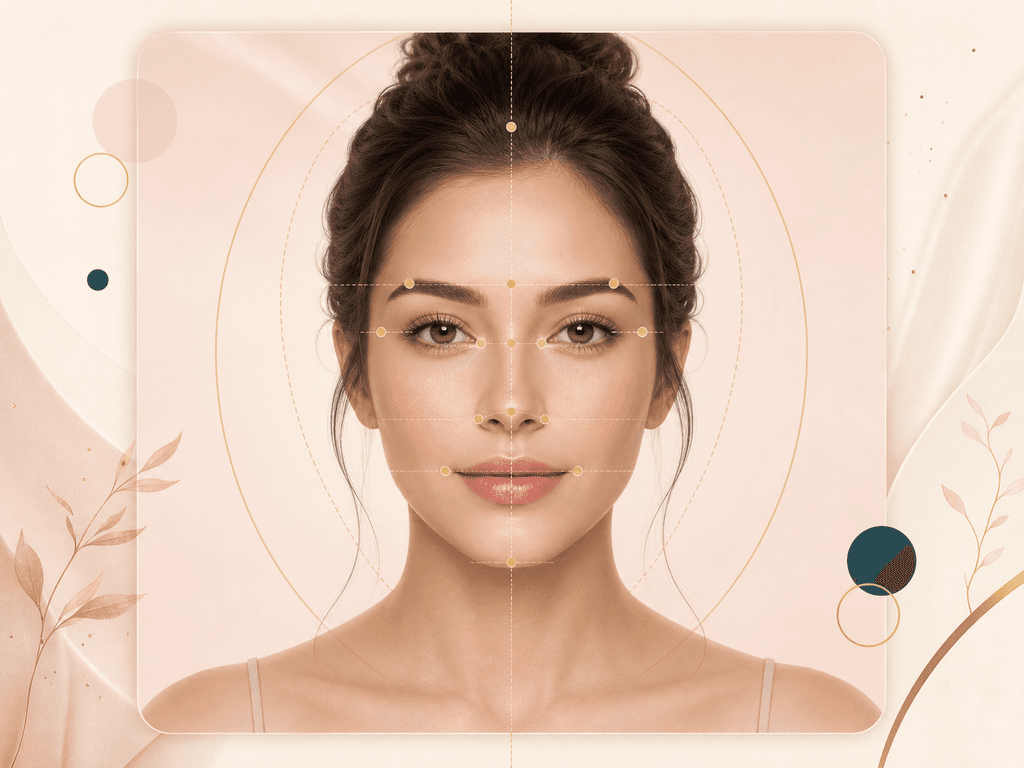
For a more consistent assessment, users should select a clear, front-facing photograph with natural lighting. The camera should ideally be positioned at eye level, and the face should remain relaxed. Extreme facial expressions, tilted heads, and unusual camera angles can change the apparent distance between facial features.
A typical assessment process involves the following steps:
-
Choose a clear photograph with the entire face visible.
-
Position the face directly toward the camera.
-
Allow the tool to identify important facial landmarks.
-
Review the measurements and understand the resulting ratios.
-
Treat the final score as an estimate rather than a beauty judgment.
Some tools allow manual measurements instead of automatic photograph analysis. In such cases, consistency is especially important. Measuring from different reference points can produce significantly different results, even when examining the same face.
Benefits of Understanding Facial Proportions
Learning about facial proportions can be useful for people interested in beauty, grooming, photography, makeup, and personal styling. It provides a structured way to understand how different facial features relate to one another. Rather than focusing only on individual characteristics, users can explore the overall relationship between the forehead, eyes, nose, mouth, cheeks, and chin.
For makeup enthusiasts, understanding facial proportions may help with contour placement, highlighting, eyebrow shaping, and other styling techniques. For example, someone with a wider forehead may experiment with different hairstyles to create a preferred visual balance. Similarly, people interested in photography may use facial measurements to understand how camera angles influence the appearance of facial features.
The concept can also be useful in digital design, character creation, portrait illustration, and beauty education. Artists sometimes study facial proportions to develop more realistic drawings, while photographers may explore facial structure to understand lighting and composition.
However, these benefits should not encourage people to change their natural appearance simply to match a mathematical number. Personal style, comfort, and individual preferences remain more meaningful than achieving an exact numerical ratio.
Limitations of Golden Ratio Facial Analysis
Although facial measurement tools can provide interesting numerical information, they have several limitations. The first limitation is that attractiveness is subjective. People from different cultures, age groups, and backgrounds may have different preferences regarding facial features. A mathematical formula cannot represent every personal or cultural understanding of beauty.
Another limitation is measurement accuracy. Photographs are two-dimensional representations of three-dimensional facial structures. Camera distance, lens distortion, lighting, facial expressions, and head positioning can affect the measurements generated by digital systems. Even a small change in photograph positioning may influence the calculated proportions.
There is also a difference between facial symmetry and facial attractiveness. Symmetry refers to the degree of similarity between the two sides of the face, while attractiveness involves a much wider combination of characteristics. Skin appearance, facial expressions, personality, grooming, and individual preferences can all influence how someone is perceived.
A golden ratio face calculator should therefore be used as an educational or entertainment tool. Its results should not be treated as medical information, a professional assessment, or proof that someone meets or fails a particular beauty standard.
Golden Ratio Face Calculator vs. Traditional Facial Analysis
Traditional facial analysis generally involves observing the overall structure of the face and identifying its major characteristics. This may include examining face shape, cheekbone placement, jawline definition, and the relationship between different facial features. The process can be subjective because different observers may interpret the same facial structure differently.
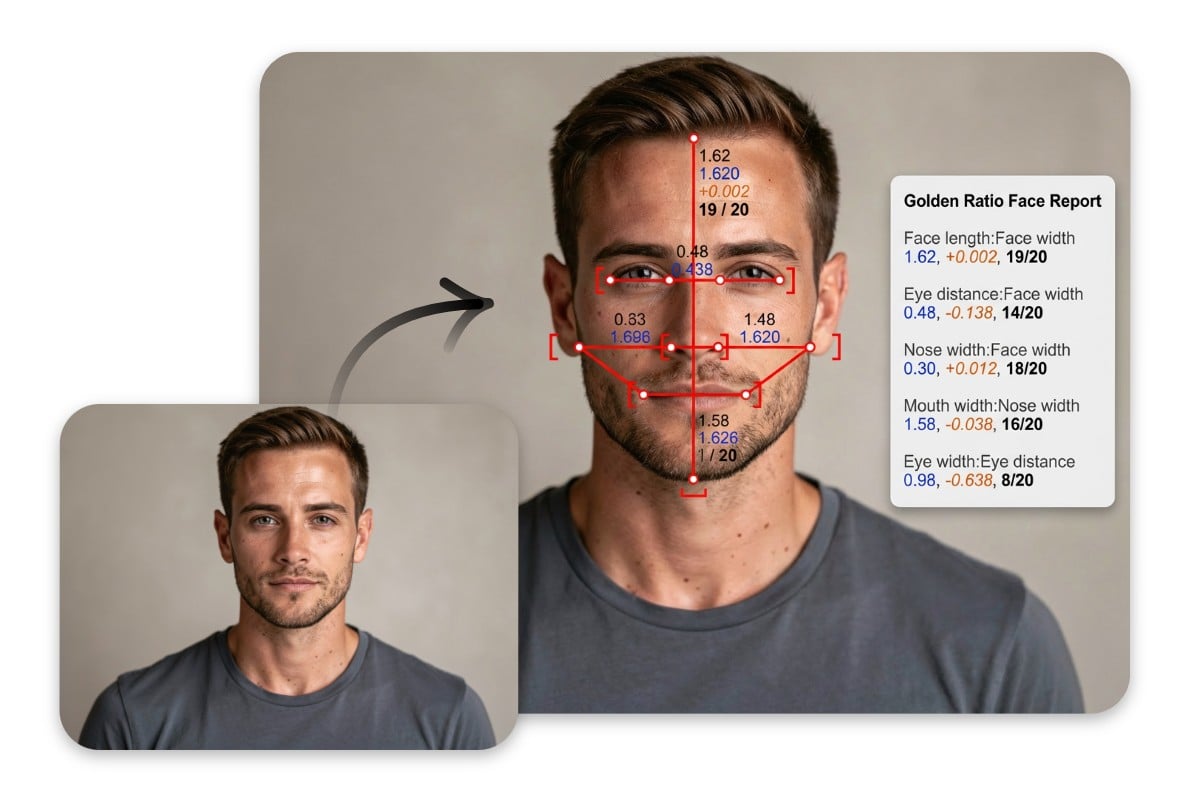
Digital ratio analysis introduces numerical measurements into this process. It can provide estimates of distances and proportions, making it easier to compare selected facial dimensions. However, digital analysis does not necessarily provide a more complete understanding of appearance.
The two approaches can complement each other when used appropriately. Traditional observation helps explain the overall visual appearance, while mathematical measurements provide additional information about facial geometry. Combining both perspectives creates a more balanced understanding than depending entirely on a numerical score.
Tips for Interpreting Your Facial Analysis Results
When reviewing facial measurements, it is important to understand what the numbers actually represent. A ratio close to 1.618 may indicate that two selected measurements have a relationship similar to the golden ratio. It does not establish that the entire face follows the same mathematical pattern.
Users should also avoid comparing their scores with those of celebrities, influencers, or people featured in beauty-related content. Different photographs, camera settings, facial expressions, and analysis methods can produce inconsistent results. Comparing scores from unrelated calculators may also create confusion because their formulas may not be identical.
Instead, consider the measurements as a way to learn about facial geometry. If a particular result seems unusual, check whether the photograph was properly aligned and whether the calculator clearly explains its measurement method. Understanding the limitations of the technology is just as important as understanding its results.
The Role of AI in Modern Facial Proportion Analysis
Artificial intelligence is changing the way digital beauty tools examine facial characteristics. Modern computer vision systems can identify facial landmarks, estimate distances, and process images with relatively little manual input. These capabilities have made facial analysis more accessible to ordinary users.
AI-powered applications can also provide visual overlays that mark the position of the eyes, nose, lips, forehead, and chin. Some systems compare different facial dimensions and present the results through charts or numerical scores. This makes it easier for users to understand which measurements are being considered during the assessment.
However, AI systems are not perfect. Their results can vary depending on image quality, training data, lighting conditions, and the diversity of facial structures represented in their development. Privacy is another important consideration because facial photographs contain biometric information. Users should understand how an application processes, stores, and handles uploaded images before sharing personal photographs.
As these technologies continue to develop, facial analysis tools may become more detailed and interactive. Even so, responsible use requires understanding that technology can measure certain physical characteristics but cannot define an individual’s overall beauty or worth.
Conclusion
The golden ratio offers an interesting mathematical perspective on facial proportions, helping people explore the relationships between facial length, width, eye spacing, nose dimensions, lips, and other features. Digital analysis has made these measurements easier to understand by introducing automated landmark detection and numerical comparisons.
A golden ratio face calculator can be a useful tool for learning about facial geometry, experimenting with beauty concepts, and understanding how different features contribute to overall facial structure. However, its results should always be interpreted carefully because the golden ratio is not a universal or scientifically definitive standard of attractiveness.
Every face has its own structure, proportions, and distinctive characteristics. Instead of trying to achieve a perfect mathematical score, people should focus on understanding their natural features and developing a personal style that makes them feel confident. True beauty is much broader than numbers, measurements, or mathematical formulas.

.jpg&description=Discover how a golden ratio face calculator measures facial proportions, analyzes symmetry, and explains the mathematics behind traditional beauty standards.)