
Understanding your face shape can make a surprising difference when choosing hairstyles, eyeglasses, makeup techniques, and accessories. Every person has a different facial structure, influenced by the proportions of the forehead, cheekbones, jawline, and overall face length. While some people can easily recognize their facial shape by looking in the mirror, others find it difficult to distinguish between similar categories such as oval, round, square, and heart-shaped faces. This is where modern facial analysis technology becomes useful.
A face shape detector is a digital tool designed to analyze facial features and estimate the shape of a person’s face. It generally uses a photograph, camera input, or artificial intelligence to identify important facial landmarks and examine the proportions between different areas. Instead of relying entirely on personal judgment, users can receive an estimated result that helps them understand their facial structure more clearly.
With the growing popularity of artificial intelligence, online beauty tools, and personalized styling applications, facial shape identification has become easier and more accessible. People can explore their appearance, experiment with different styling ideas, and make more informed beauty decisions without necessarily visiting a professional stylist. However, understanding how these tools work and interpreting their results correctly is equally important.
What Is a Face Shape Detector?
A face shape detector is an online or mobile-based technology that examines facial proportions to identify the most likely face shape. It focuses on the relationship between the forehead, cheekbones, jawline, and chin. These measurements help determine whether someone has an oval, round, square, rectangular, diamond, heart, or another facial structure.
Most modern tools use facial recognition techniques and computer vision to locate specific points on the face. These points, commonly called facial landmarks, include the corners of the eyes, edges of the forehead, cheekbone positions, jawline, and chin. By comparing the distances between these landmarks, the software estimates the overall facial proportions and categorizes the result.
The technology is particularly useful for people who want personalized styling suggestions. For example, someone with a round face might explore hairstyles that create the appearance of additional length, while someone with a square face might prefer styles that introduce softer visual lines. The result is not a fixed beauty standard but a starting point for understanding individual facial characteristics.
How Does Face Shape Detection Technology Work?
Facial Landmark Recognition
Facial landmark recognition is one of the main technologies behind automated face analysis. When a user uploads a photograph or activates a camera, the software identifies important points across the face. These points help the system understand the position and proportions of different facial features.
For example, the distance between the temples can provide information about forehead width, while the distance across the cheekbones helps establish the widest part of the face. The software may also examine the jawline and the length from the hairline to the chin. By combining these measurements, it creates a simplified representation of the facial structure.
Artificial Intelligence and Image Processing
Artificial intelligence has made facial analysis tools more sophisticated. Some applications use machine learning models trained on large collections of facial images to recognize patterns associated with different face shapes. These models learn how facial proportions commonly differ between categories and use that information when analyzing new photographs.
Image processing also plays an important role. Lighting, image quality, camera positioning, and facial orientation can influence the accuracy of the analysis. A photograph taken from a very low angle, for instance, may make the jawline appear different from its natural appearance. This is why users should provide clear, front-facing photographs whenever possible.
Different Types of Face Shapes
Understanding the main facial categories makes it easier to interpret the results of automated analysis. Although individual faces can combine characteristics from multiple categories, seven commonly recognized shapes provide a useful foundation.
1. Oval Face Shape
An oval face is generally characterized by a balanced appearance, with a forehead slightly wider than the jawline and a gently rounded chin. The overall face length is usually greater than its width. Because its proportions are relatively balanced, this shape can work well with many hairstyles, including long layers, short cuts, side parts, and medium-length styles.
People with oval faces often have considerable flexibility when experimenting with different accessories. However, personal preferences, hair texture, and individual features remain important when selecting a particular look.
2. Round Face Shape
A round face typically has similar measurements across its width and length, with fuller cheeks and a softly curved jawline. The cheekbones are often the widest area, while the chin does not have a sharply defined angle.
Hairstyles that create additional height or vertical lines can complement this structure. Long layers, side-swept bangs, and hairstyles with volume near the crown are popular options. Angular eyeglass frames can also introduce visual contrast.
3. Square Face Shape
A square face is commonly identified by a broad forehead, prominent cheekbones, and a strong jawline. The width of the forehead, cheekbones, and jaw is often relatively similar, creating a more angular appearance.
People with square faces may enjoy hairstyles with soft layers, textured ends, or waves that create a balanced appearance around the jawline. Rounded or oval eyeglass frames can also provide an interesting contrast to naturally angular facial features.
4. Heart Face Shape
A heart-shaped face generally features a wider forehead, prominent cheekbones, and a narrower chin. The upper portion of the face is visually broader, while the lower portion gradually becomes narrower.
Medium-length hairstyles, side parts, and soft layers can complement this structure. Frames that are wider near the lower portion may also help create a balanced appearance. The objective is not to hide the forehead or chin but to explore styles that work naturally with existing proportions.
5. Diamond Face Shape
A diamond face is usually characterized by prominent cheekbones, a relatively narrow forehead, and a narrower chin. The cheekbones are often the widest part of the face, making this category visually distinct.
Soft bangs, layered hairstyles, and chin-length cuts can complement diamond-shaped faces. When selecting glasses, oval and rimless designs may be worth exploring because they can work well with prominent cheekbones.
6. Rectangular Face Shape
A rectangular face is longer than it is wide, with relatively straight sides and a more elongated appearance. The forehead, cheekbones, and jawline may have similar widths, creating a longer facial outline.
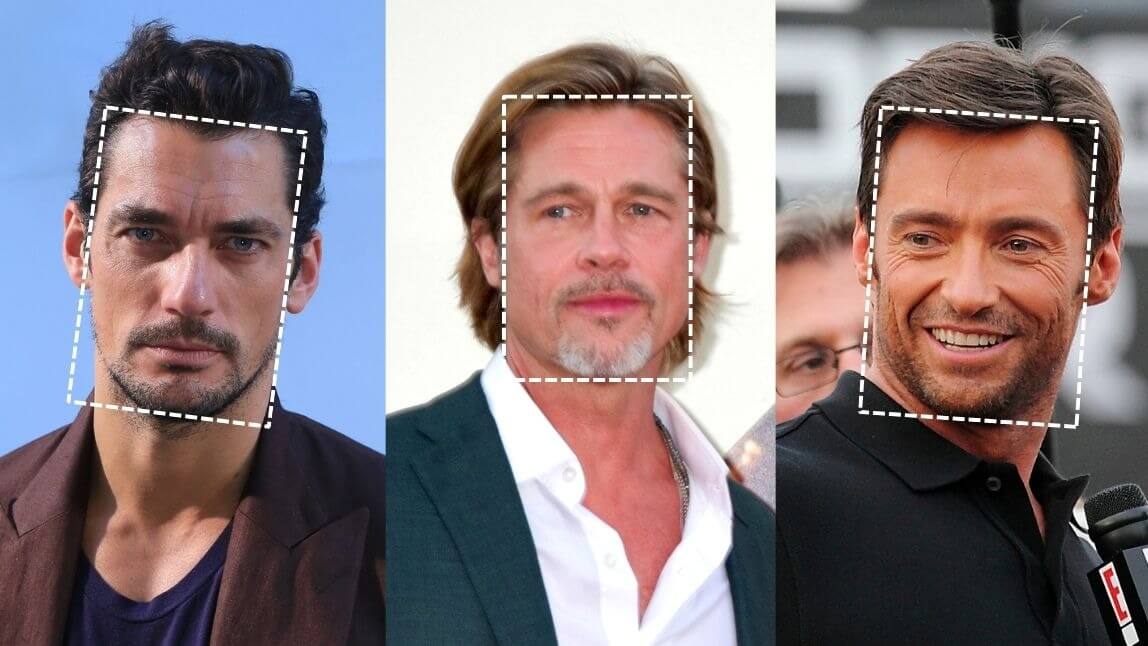
Hairstyles that introduce width around the sides can help create visual balance. Medium-length cuts, soft waves, and layered styles are common choices. Wider eyeglass frames can also complement the proportions.
7. Triangle Face Shape
A triangular face generally has a wider jawline and a narrower forehead. The lower portion of the face appears more prominent, creating a distinctive facial outline.
Hairstyles with volume around the forehead and temples can create a balanced appearance. Textured layers and side-swept styles are useful options for people who want to experiment with different proportions.
How to Use a Face Shape Detector Online
Using an online facial analysis tool is generally straightforward. Most platforms are designed for beginners and do not require technical knowledge. Depending on the application, users can upload an existing photograph or take a new picture directly through their device’s camera.
For a more consistent result, follow these simple steps:
-
Choose a clear, front-facing photograph with good lighting.
-
Keep your head straight and look directly toward the camera.
-
Move hair away from the forehead and sides of the face.
-
Upload the image and allow the tool to analyze facial proportions.
-
Review the suggested face shape and compare it with your actual features.
After receiving the result, avoid treating the classification as a permanent label. Some faces have characteristics associated with multiple categories. Comparing the estimated result with your forehead, cheekbone, jawline, and face-length measurements can provide a better understanding of your overall structure.
Face Shape Comparison: Understanding the Differences
The following table explains the basic characteristics of common facial shapes and the features that generally distinguish them.
| Face Shape | Main Characteristics | Widest Area |
|---|---|---|
| Oval | Balanced proportions, rounded chin | Cheekbones |
| Round | Fuller cheeks, soft jawline | Cheeks |
| Square | Angular jawline, broad forehead | Forehead and jaw |
| Heart | Wider forehead, narrow chin | Forehead |
| Diamond | Prominent cheekbones, narrow forehead | Cheekbones |
| Rectangle | Longer facial proportions | Forehead and jaw |
| Triangle | Narrow forehead, wider jaw | Jawline |
These descriptions are general guidelines rather than strict measurements. Real facial structures often contain a mixture of characteristics, so two people classified under the same category may still look noticeably different.
Benefits of Using Digital Face Shape Analysis
Choosing More Suitable Hairstyles
One of the biggest advantages of facial shape analysis is its usefulness when selecting hairstyles. Haircuts can change the visual balance of the face by introducing volume, reducing width, or creating additional length. Knowing the general structure of your face gives you a better starting point when discussing haircut options with a hairstylist.
For example, someone with a rectangular face might prefer styles that add width around the cheeks, while someone with a round face may experiment with layered hairstyles that create a longer appearance. These are styling suggestions rather than fixed rules, and hair density, texture, and personal preferences should also influence the final decision.
Selecting Eyeglasses and Sunglasses
Eyeglasses are another area where facial proportions can be useful. Different frame designs create different visual effects. Angular frames may contrast with softer facial outlines, while rounded frames can complement more angular structures.
A face shape detector can help narrow down the frame styles worth exploring. However, comfort, bridge width, frame size, prescription requirements, and personal taste are equally important. The most suitable glasses are those that fit properly and make the wearer feel confident.
Improving Makeup Placement
Understanding facial proportions can also help people experiment with makeup. Contouring, highlighting, and blush placement can influence how different facial areas appear. For example, some people prefer applying blush slightly higher on the cheeks, while others experiment with softer contouring around the jawline.
The goal should be to understand how different techniques affect appearance rather than follow a single makeup formula. Individual features, skin type, and personal style matter more than a general face category.
Common Factors That Affect Detection Accuracy
Although automated facial analysis can be convenient, its results are not always perfectly accurate. One important factor is photograph quality. Poor lighting, shadows, filters, and low-resolution images can make it difficult for software to identify facial boundaries correctly.
Camera angles can also influence the outcome. A photograph taken from above may make the jaw appear narrower, while a close-up selfie can distort proportions because of lens perspective. Facial expressions can introduce additional differences, particularly around the cheeks and jawline.
Another consideration is hairstyle. Hair covering the forehead or sides of the face can prevent a tool from identifying the natural facial outline. Similarly, some systems may interpret facial measurements differently because they use different algorithms or classification methods.
For these reasons, users should consider the results as estimates. If two applications provide slightly different classifications, it does not necessarily mean that one is completely wrong. The difference may come from their measurement techniques and the way they define facial categories.
Privacy and Safety When Uploading Facial Photographs
Facial photographs contain personal information, so privacy should be considered before using online analysis services. Not every platform handles uploaded images in the same way. Some applications may process photographs temporarily, while others may retain uploaded content according to their privacy policies.
Before uploading a photograph, users should understand how the platform collects, processes, and stores image data. It is also worth checking whether the application shares information with third parties or uses submitted photographs to improve its technology.
A responsible approach includes choosing reputable services, reviewing privacy settings, avoiding unnecessary permissions, and deleting uploaded photographs when the platform provides that option. Users should also be cautious about applications that request unrelated personal details or demand extensive device access for a simple styling feature.
Manual Methods to Identify Your Face Shape
Digital tools are not the only way to understand facial proportions. People can also estimate their face shape using a mirror and a flexible measuring tape. This approach is particularly useful when someone wants to compare facial measurements independently.
Start by measuring the width of your forehead at its broadest point. Next, measure across the cheekbones, followed by the width of the jawline. Finally, measure the distance from the center of your hairline to the bottom of your chin. If your hairline is difficult to identify, use the visible facial proportions as a general reference.
Compare the measurements rather than focusing on one number. A longer face with balanced forehead and jaw measurements may suggest a rectangular or oval structure, while a face with prominent cheekbones and a narrow chin may resemble a diamond shape.
Why Manual Measurements Can Be Helpful
Manual measurement allows people to understand which facial areas are wider or narrower. It also helps them question an automated result when the suggested category does not seem to match their appearance.
However, measurements should not become an unnecessary source of concern. Natural facial asymmetry is normal, and most people do not fit perfectly into one category. The purpose of identifying facial structure is to discover useful styling possibilities, not to judge appearance through numerical measurements.
How to Choose the Right Face Analysis Tool
Not all facial analysis applications offer the same features. Some provide only a basic face category, while others include facial landmark visualization, hairstyle recommendations, glasses suggestions, and additional styling features.
When selecting a platform, consider whether it explains how its results are generated. A useful application should present its findings clearly without making exaggerated claims about accuracy. It should also offer a simple interface, reasonable privacy practices, and compatibility with commonly used devices.
It is also helpful to understand the difference between face shape analysis and facial recognition. Face shape analysis focuses on proportions and general structure, whereas facial recognition technology may be designed to identify or verify a person’s identity. These technologies serve different purposes and should not be confused.
Future of AI-Based Facial Shape Analysis
Artificial intelligence is continuing to influence beauty technology and personalized digital experiences. As computer vision systems improve, facial analysis applications may become better at identifying subtle differences in facial proportions and providing more detailed styling suggestions.
Future tools could combine face shape analysis with virtual hairstyle previews, eyewear simulations, and personalized makeup recommendations. Instead of simply assigning a category, applications may offer interactive experiences that allow users to compare different styles using their own photographs.
At the same time, privacy, transparency, and responsible AI development will remain important. More sophisticated analysis does not automatically guarantee better results, particularly when photographs have poor quality or the underlying models do not account for diverse facial characteristics.
The most useful developments will likely be those that combine accurate measurements with flexible recommendations. Users should remain in control of their appearance choices rather than allowing automated classifications to determine what they should or should not wear.
Conclusion
Understanding your facial structure can make everyday styling decisions easier and more enjoyable. From selecting flattering hairstyles and eyeglasses to exploring makeup techniques, knowing the general proportions of your face provides a useful foundation for personal grooming and fashion choices.
A face shape detector makes this process more convenient by using image processing, facial landmarks, and artificial intelligence to estimate facial proportions. Although these tools can provide helpful insights, their results should always be considered approximate because lighting, camera angles, image quality, and natural facial variations can influence the outcome.
Ultimately, identifying your face shape is about discovering new styling possibilities rather than following strict beauty rules. Whether you use an online tool or manual measurements, the best approach is to understand your natural features, experiment with different looks, and choose the styles that make you feel comfortable and confident.