
Beauty has always been an interesting subject because everyone has different opinions about what makes a face attractive. Some people admire balanced facial features, while others appreciate distinctive eyes, a well-defined jawline, a beautiful smile, or unique facial expressions. Although beauty is subjective, mathematics has introduced an interesting way to study facial proportions. One popular concept is the golden ratio, a mathematical relationship that has been associated with balance, symmetry, and visual harmony for centuries.
A golden ratio face calculator is a digital tool designed to examine facial proportions using measurements inspired by the mathematical golden ratio. It generally evaluates different areas of the face, including the distance between the eyes, facial width, nose proportions, forehead dimensions, and the relationship between facial length and width. By comparing these measurements with selected proportional guidelines, users can explore how their facial features relate to traditional mathematical ideas about balance.
In recent years, interest in facial analysis tools has increased because of beauty applications, photography technology, artificial intelligence, and online appearance-related trends. People are increasingly curious about how facial measurements work and whether mathematical proportions can explain attractiveness. However, understanding these tools requires looking beyond numerical scores and recognizing that individual features, cultural preferences, expressions, and personal characteristics all contribute to appearance.
Understanding the Golden Ratio in Facial Proportions
The golden ratio is a mathematical constant represented by the Greek letter phi (φ). Its approximate value is 1.6180339887. It describes a relationship in which a larger measurement compared with a smaller measurement has approximately the same proportion as their combined total compared with the larger measurement.
This mathematical relationship appears in different areas of mathematics, architecture, art, design, and nature. For example, designers sometimes use golden ratio-inspired proportions when creating layouts, illustrations, and visual compositions. The concept has also become popular in discussions about facial beauty because some researchers and beauty enthusiasts have explored whether balanced facial measurements influence how people perceive attractiveness.
When applied to facial proportions, the golden ratio is generally used as a reference rather than a universal measurement of beauty. Certain facial distances can be compared to investigate whether they follow proportions close to 1.618. However, real human faces are naturally diverse, and there is no scientifically established golden ratio formula that determines whether someone is attractive.
How Does a Golden Ratio Face Calculator Work?
A golden ratio face calculator typically works by examining facial measurements and comparing selected distances with proportional guidelines. Depending on the tool, users may upload a photograph, position facial landmarks manually, or use an automated face detection system. The technology identifies important facial points and calculates distances between them to produce an analysis.
For example, a calculator may examine the relationship between facial length and width. It might also evaluate the distance between the eyes, the width of the nose, the proportions of the lips, and the relationship between the forehead and lower face. These measurements are then compared with predefined mathematical references. Some tools present the findings through percentages, visual guides, or an overall numerical score.
Modern facial analysis systems may use artificial intelligence and computer vision to identify facial landmarks. These systems can recognize the approximate positions of the eyes, eyebrows, nose, mouth, chin, and jawline. Once these points are identified, the software calculates distances and relationships between them. The final result depends on the accuracy of the photograph, the quality of the detection system, and the particular formula used by the calculator.
The Role of Facial Landmarks
Facial landmarks are specific points on the face that help software understand its structure. They provide a foundation for measuring proportions because distances between these points can be calculated more consistently than measurements based on general visual impressions.
For instance, the inner corners of the eyes can help estimate eye spacing, while the tip of the nose and the bottom of the chin can contribute to measurements of facial length. Similarly, points around the cheekbones and jawline can help estimate facial width. A well-designed analysis tool uses several landmarks rather than depending on a single measurement.
However, facial landmark detection is not always perfect. Poor lighting, camera angles, facial expressions, makeup, and image quality can affect the results. This means that measurements should be treated as approximate rather than completely accurate representations of someone’s natural facial structure.
Important Facial Measurements Used in Golden Ratio Analysis
A facial proportion analysis can involve several measurements that describe the relationships between different facial features. These measurements help users understand how facial geometry works and why certain proportions attract attention in traditional beauty discussions.
One commonly discussed measurement is the relationship between facial length and width. Facial length is generally measured vertically, while width is estimated horizontally across prominent areas of the face. Their relationship provides a basic understanding of facial shape and proportions. However, different face shapes naturally have different measurements, and none should automatically be considered better than another.
Eye spacing is another important measurement. The distance between the eyes can influence how facial features appear together. Nose width and length may also be considered when studying facial balance. Similarly, the proportions of the lips, chin, and jawline contribute to the overall appearance of the lower face.
The following table explains some measurements that may appear in facial proportion analysis.
| Facial feature | What is measured | Purpose |
|---|---|---|
| Facial length | Forehead area to chin | Studies vertical proportions |
| Facial width | Distance across the cheeks | Examines horizontal balance |
| Eye spacing | Distance between the eyes | Evaluates eye placement |
| Nose width | Width around the nostrils | Studies central facial proportions |
| Lip proportions | Upper and lower lip dimensions | Examines mouth balance |
| Jawline | Width and shape of the lower face | Studies lower facial structure |
These measurements provide a simplified overview of facial geometry. Different calculators may use different landmark positions, measurement methods, and mathematical comparisons, so their results are not necessarily identical.
Benefits of Using a Golden Ratio Face Calculator
A golden ratio face calculator can be useful for people who are curious about facial geometry and want to explore how different facial measurements relate to one another. Instead of relying entirely on subjective impressions, users can examine approximate measurements and understand how proportions contribute to the overall appearance of a face.
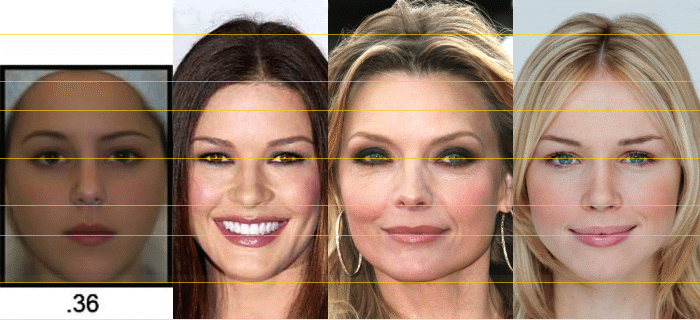
One major advantage is accessibility. Many online facial analysis tools allow users to experiment with facial measurements without requiring professional equipment or technical knowledge. A photograph may be enough to generate a basic analysis, depending on the platform. This makes mathematical facial analysis easier to explore for beginners.
Another benefit is educational value. Users can learn about symmetry, proportions, facial landmarks, and mathematical relationships through practical examples. Students interested in mathematics, photography, digital design, or computer vision may also find these tools interesting because they demonstrate how numerical concepts can be applied to real-world images.
For photographers and digital artists, facial proportion analysis can provide another perspective on composition. Understanding facial geometry may help when studying portrait photography, character illustration, and digital modeling. Nevertheless, these applications should focus on creative exploration rather than attempting to make every face conform to identical measurements.
How to Use a Golden Ratio Face Calculator Correctly
Using a golden ratio face calculator is generally straightforward, but the quality of the result depends heavily on how the photograph is captured. A clear, front-facing photograph usually provides better conditions for identifying facial landmarks. The face should be visible without strong shadows, excessive filters, or objects covering important features.
Most tools follow a similar process, although the exact steps depend on the platform.
-
Open a facial proportion calculator that explains its measurement method.
-
Upload a clear photograph or use its manual measurement feature.
-
Allow the system to identify important facial landmarks.
-
Review the measurements and understand what each result represents.
-
Compare the findings as mathematical estimates rather than beauty judgments.
It is important to avoid interpreting a single score as a complete assessment of facial appearance. A calculator measures selected dimensions, not personality, confidence, expressions, or the many qualities that influence how people experience beauty.
Choosing the Right Photograph
Photograph quality can significantly influence facial measurement results. A picture taken from an extreme angle may make the nose appear larger or change the apparent width of the face. Similarly, a close-up selfie can introduce perspective distortion because the camera is positioned near the subject.
For more consistent measurements, use a photograph captured at approximately eye level with the face directed toward the camera. Natural, even lighting can help facial detection systems identify important points. Keeping a neutral expression also makes it easier to compare measurements across different photographs.
Another important consideration is camera distance. A photograph taken from a moderate distance generally reduces perspective distortion compared with an extremely close selfie. If the tool allows manual landmark adjustment, checking the detected points can also improve the quality of the analysis.
Golden Ratio, Facial Symmetry, and Natural Beauty
Facial symmetry and the golden ratio are related topics, but they are not the same thing. Symmetry refers to how closely the left and right sides of the face resemble one another. The golden ratio, on the other hand, describes a particular mathematical relationship between measurements.
A face can have relatively symmetrical features without following golden ratio-inspired proportions. Similarly, a person may have facial measurements that resemble certain golden ratio references while displaying noticeable natural asymmetry. Both situations are normal because human faces develop through a combination of genetics, growth, environmental influences, and individual variation.
Researchers have studied facial symmetry and attractiveness, but findings do not support the idea that perfect symmetry or a single mathematical proportion determines beauty. Facial attractiveness involves several interacting factors, including feature relationships, skin appearance, expressions, familiarity, and personal preferences.
Natural asymmetry can also contribute to individuality. Small differences between the eyes, eyebrows, cheeks, and mouth are common. These details often make faces recognizable and distinctive. Therefore, a mathematical calculator should never be treated as a standard that every person needs to achieve.
Can a Golden Ratio Face Calculator Determine Your Attractiveness?
One of the most common questions surrounding facial analysis tools is whether they can determine how attractive someone is. The simple answer is no. They can calculate selected facial proportions, but attractiveness is much more complicated than a mathematical equation.
A numerical score may look impressive, but it usually represents the software’s interpretation of a particular measurement system. It does not establish an objective beauty ranking. Different platforms can produce different results because they may use different facial landmarks, formulas, image-processing techniques, and scoring methods.
Human perception is also influenced by cultural background, personal experiences, social preferences, and individual taste. A facial feature considered attractive in one environment may be viewed differently in another. Expressions and confidence can also influence how someone is perceived.
A golden ratio face calculator should therefore be approached as an educational or entertainment tool. Its purpose is to provide information about facial proportions, not to decide whether someone is beautiful or needs to change their appearance.
Limitations of Online Facial Analysis Tools
Although digital facial analysis has become more sophisticated, online calculators still have several limitations. Their accuracy depends on the quality of the uploaded photograph, the underlying detection technology, and the mathematical model used for evaluation. Even advanced artificial intelligence systems can make mistakes when identifying facial landmarks.
Another limitation is that two-dimensional photographs cannot fully represent three-dimensional facial structures. A photograph captures a face from one particular perspective, while actual facial anatomy includes depth, contours, and volume. This can make measurements less representative of natural proportions.
Some additional limitations include:
-
Different calculators may use different measurement formulas.
-
Facial expressions can change the position of important landmarks.
-
Lighting and camera distortion may affect measurements.
-
Beauty scores may reflect simplified or subjective assumptions.
Privacy is another consideration. Facial photographs are personal information, and users should understand how an online platform processes uploaded images. Before submitting a photograph, it is sensible to review the platform’s privacy policy, image storage practices, and data deletion options. Avoid uploading sensitive photographs to unfamiliar websites.
The Role of Artificial Intelligence in Modern Facial Analysis
Artificial intelligence has changed how digital tools examine facial structures. Traditional measurement methods often required users to identify facial points manually, while modern computer vision systems can automatically recognize multiple landmarks within a photograph.
These systems use trained algorithms to detect facial features and estimate their positions. Once the landmarks are identified, mathematical calculations can be performed to examine distances, angles, and proportions. This process makes facial analysis faster and more convenient for ordinary users.
Artificial intelligence can also help improve consistency when photographs meet suitable conditions. For example, a system may identify the same general facial landmarks across multiple images and compare their approximate positions. However, accuracy still depends on image quality, training data, camera conditions, and the design of the algorithm.
It is also important to understand that AI-generated scores are not necessarily scientific measurements of attractiveness. An algorithm can calculate a distance accurately while still relying on an arbitrary assumption about which proportion should be considered ideal. Users should distinguish between mathematical accuracy and the validity of the conclusions drawn from those calculations.
Golden Ratio in Photography, Makeup, and Personal Styling
The golden ratio concept has applications beyond online facial calculators. Photography, makeup, and personal styling frequently involve visual balance and proportion. Understanding these ideas can help people make creative choices that complement their natural features.
Portrait photographers often pay attention to facial positioning, camera distance, lighting, and composition. These elements can influence how facial features appear in photographs. For example, changing the camera angle or lighting direction can create different impressions of cheekbone definition and facial depth.
Makeup artists also work with facial proportions when selecting techniques for contouring, highlighting, eyebrow shaping, and lip definition. Rather than following one mathematical formula, professional makeup techniques usually consider the individual’s face shape, skin tone, preferences, and desired appearance.
Similarly, hairstyle choices can influence how facial proportions are visually perceived. Layers, fringes, volume, and different hair lengths can create different impressions of facial length and width. The most useful approach is to experiment with styles that reflect personal preferences instead of attempting to achieve an artificial mathematical ideal.
Common Myths About Golden Ratio Facial Measurements
Several misconceptions have developed around mathematical facial beauty. One widespread myth is that every attractive person must have facial proportions matching the golden ratio. In reality, there is no universally accepted scientific formula that establishes this relationship as a requirement for attractiveness.
Another misconception is that facial symmetry means both sides must be identical. Human anatomy naturally includes minor differences, and perfect symmetry is neither common nor necessary for an appealing appearance. Digital photographs can also make these differences appear more noticeable than they are in everyday interactions.
Some people also assume that a high facial score guarantees that others will consider them attractive. This overlooks the influence of expressions, social context, individual preferences, and personal characteristics. A numerical result cannot capture the complete experience of human beauty.
Understanding these myths helps users approach facial analysis with realistic expectations. Mathematical tools can explain certain aspects of facial geometry, but they cannot replace the complexity of human appearance.
Conclusion
The golden ratio offers an interesting mathematical perspective on facial proportions, symmetry, and visual balance. A golden ratio face calculator makes these concepts easier to explore by identifying facial landmarks, measuring selected distances, and comparing them with traditional proportional references. It can be an educational resource for people interested in mathematics, photography, digital beauty tools, and facial geometry.
However, numerical measurements should never become the final standard for evaluating personal appearance. Every face has distinctive characteristics, and beauty cannot be reduced to one mathematical equation or computer-generated score. Facial symmetry, expressions, individuality, and cultural preferences all contribute to how people perceive appearance.
Ultimately, the best way to use facial analysis technology is with curiosity and a balanced perspective. Explore the measurements, understand the mathematics, and enjoy learning about facial proportions without comparing your natural features against unrealistic standards. Beauty is diverse, personal, and far more interesting than a single number.